Jan. 15, 2026
A viral claim suggesting that white kittens are "unpopular" and often rejected by their feline peers has recently circulated on social media, sparking concerns among cat owners. However, animal behaviorists and scientific research have firmly debunked this myth, clarifying that feline social interactions rely on sensory cues far beyond fur color, with no such thing as "appearance bias" in the cat world.
Firstly, cats' visual capabilities do not support "fur color aesthetics." As dichromats, cats primarily perceive blues, greens, and grays, unable to distinguish colors like red or appreciate the "visual hierarchy" of multicolored fur that humans do. For them, fur color is just a vague visual signal, not a criterion for judging peers. A study by the SPCA Cincinnati further confirms that feline socialization hinges on scent, familiarity, and early experiences rather than appearance.
Scent is the core "social ID" for cats. With an olfactory sensitivity 40 times that of humans, they identify companions through pheromones, which convey information about health, territory, and familiarity. Experiments show that cats are more relaxed around unfamiliar-colored cats with familiar scents than same-colored cats with strange scents. The occasional isolation of white cats observed by some netizens is often due to territorial conflicts or lack of early socialization, not color-based rejection.
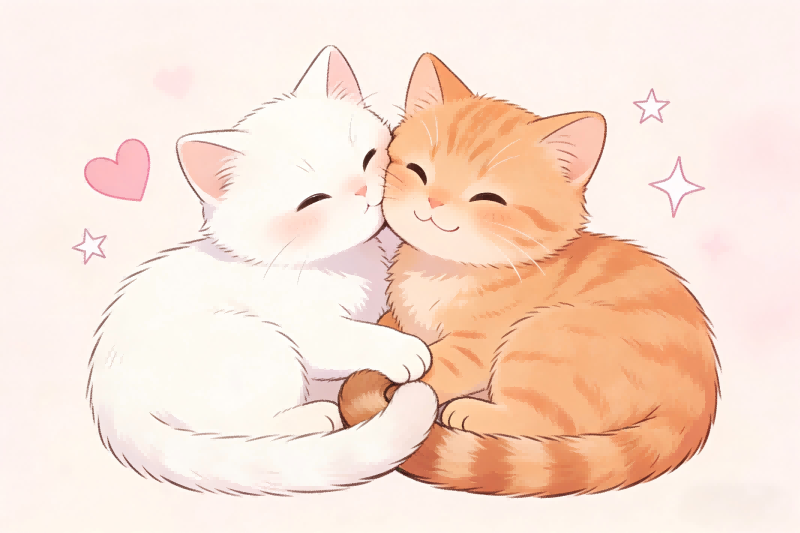
Animal behavior experts emphasize that early social experiences (3-6 weeks of age) and genetic factors are key to feline social skills. For multi-cat households, gradual scent adaptation and providing sufficient resources can help cats establish harmonious relationships. The "white cat rejection" claim is essentially an anthropomorphic misinterpretation, projecting human aesthetic biases onto animals.